
-
Home
-
Expertise
-
About us
-
Properties
-
Land
-
Market Insights
-
Contact
- PT
- ES
- EN
- FR
- Português
- Español
- English
- Français

Frequently asked questions
You can edit text on your website by double clicking on a text box on your website. Alternatively, when you select a text box a settings menu will appear.
?
Buying Property in Brazil: Frequently Asked Questions
Buying Property in Brazil: Frequently Asked Questions
Answers to the most frequently asked questions about buying property in Brazil as a foreign investor: purchase procedures, legal requirements, taxation, investor visas, rental yields and real estate investment opportunities.
Answers to the most frequently asked questions about buying property in Brazil as a foreign investor: purchase procedures, legal requirements, taxation, investor visas, rental yields and real estate investment opportunities.
Frequently asked questions
You can edit the text on your site by double-clicking a text box. Alternatively, when selecting a text box, a settings menu will be displayed.
2
What documents and legal requirements are needed to buy property in Brazil from abroad?
What documents and legal requirements are needed to buy property in Brazil from abroad?
Foreign investors must obtain a CPF (Brazilian individual taxpayer identification number) and provide identification and civil status documents, together with evidence of residence, matrimonial property arrangements and source of funds, depending on the transaction. Foreign documents may require an apostille or legalisation and a sworn translation into Portuguese.
Property can be purchased remotely through a power of attorney granting specific powers or, where applicable, through Brazilian electronic notarial services. The acquisition process involves legal due diligence on the property and seller, contract formalisation, payment of applicable taxes and registration of the ownership title.
1
Can foreigners buy property in Brazil without living in the country?
Can foreigners buy property in Brazil without living in the country?
Yes. Foreign nationals can purchase urban real estate in Brazil, including apartments, houses and commercial properties, without holding Brazilian citizenship, a residence visa or a permanent address in the country. Buyers must obtain a CPF and comply with the applicable legal and property registration requirements.
Specific restrictions apply to rural land, certain border areas and properties subject to special land ownership regimes, including some coastal properties. Purchasing real estate in Brazil does not, by itself, make the investor a Brazilian tax resident.
3
Is it safe to buy property in Brazil? How can foreign investors protect their investment?
Is it safe to buy property in Brazil? How can foreign investors protect their investment?
Brazil has an established legal system protecting private property. However, a secure property acquisition requires appropriate legal due diligence, including verification of the property's registration record (matrícula), legal ownership, outstanding mortgages, liens, debts, legal proceedings, land restrictions and building compliance.
In an ordinary property sale, signing the purchase deed and paying the agreed price are not sufficient to transfer ownership. The title must be registered with the competent Real Estate Registry (Registro de Imóveis). Independent legal advice from a lawyer registered with the Brazilian Bar Association (OAB) is strongly recommended.
The main acquisition costs include ITBI (municipal real estate transfer tax), which generally ranges from 2% to 3% depending on the municipality, public deed fees where required, and property registration fees.
As a planning estimate, buyers should generally budget approximately 4% to 6% of the purchase price for standard transaction costs. Legal fees, due diligence, currency exchange expenses, any agency fees payable by the buyer and exceptional property regularisation costs should be assessed separately. Recurring expenses include municipal property tax (IPTU), condominium fees, maintenance and insurance.
What taxes, legal fees and closing costs should foreign buyers expect when buying property in Brazil?
What taxes, legal fees and closing costs should foreign buyers expect when buying property in Brazil?
4
5
How are rental income and capital gains from Brazilian property taxed for foreign investors?
How are rental income and capital gains from Brazilian property taxed for foreign investors?
Non-resident foreign investors can open Brazilian bank accounts, subject to each financial institution’s requirements. Although a Brazilian bank account is not a legal requirement for purchasing property, it significantly simplifies purchase payments, rental income collection and ongoing property management, including the payment of taxes, condominium fees, utility bills and other expenses.
International transfers must be arranged through institutions authorised by the Central Bank of Brazil, taking into account the source of funds, the purpose of the transaction and foreign exchange costs, including IOF and currency spreads. Proper documentation also facilitates the future resale of the property and repatriation of investment proceeds.
How do foreign investors transfer money to Brazil to buy property? Is a Brazilian bank account required?
How do foreign investors transfer money to Brazil to buy property? Is a Brazilian bank account required?
6
Purchasing urban real estate in Brazil may qualify foreign investors for a residence authorisation, sometimes referred to as the Brazilian Golden Visa. The standard minimum investment is BRL 1 million, which may be reduced to BRL 700,000 for qualifying investments in Brazil's North and Northeast regions.
The initial residence authorisation is granted for four years, with the possibility of subsequently applying for residence of indefinite duration. The regulations include a minimum physical presence requirement of 14 days in Brazil during each two-year period. Property ownership does not automatically guarantee approval: eligibility, source of funds and documentation requirements must be satisfied.
Can buying property in Brazil qualify foreign investors for a residence visa?
Can buying property in Brazil qualify foreign investors for a residence visa?
7
Where are the best places to invest in real estate in Brazil? Which cities offer capital appreciation potential?
Where are the best places to invest in real estate in Brazil? Which cities offer capital appreciation potential?
8
São Paulo and Rio de Janeiro offer established real estate markets. In southern Brazil, Florianópolis, Itajaí, Itapema and Balneário Camboriú also stand out. Northeastern Brazil offers opportunities along the coast of Alagoas, including Maceió, São Miguel dos Milagres and Maragogi, and in Ceará, including Fortaleza, Preá, Jericoacoara, Icaraí de Amontada and Fortim, where tourism and real estate development contribute to the attractiveness of these markets.
According to the October 2026 FipeZAP Index, advertised residential property prices across the monitored cities increased by an average of 5.44% over twelve months. Investors should assess location, infrastructure, demand, future supply, resale liquidity and capital appreciation potential. Past performance does not guarantee future results.
For individuals who are not Brazilian tax residents, rental income is generally subject to a 15% withholding tax, after legally permitted deductions. Capital gains from the sale of Brazilian real estate are generally taxed at progressive rates ranging from 15% to 22.5%.
Property ownership through a Brazilian limited liability company (LTDA) involves a different corporate tax framework. The implications of Brazil's tax reform, including CBS and IBS, should also be assessed. Check the tax obligations in your country of residence and whether an applicable double taxation treaty exists.
Short-term rentals through platforms such as Airbnb and Booking.com offer investment opportunities in both tourist destinations and major urban centres. An October 2026 market study identified a median gross annual rental yield of 5.9%, with the top 25% reaching 9.2% or more. Returns depend on location, purchase price, occupancy rates, nightly rates and the quality of property management.
For conventional long-term residential rentals, the average annualised gross rental yield was 6.13%, according to the October 2026 FipeZAP Index. In both rental models, net returns must account for taxation, operating expenses, maintenance, vacancy periods and exchange rate fluctuations.
What rental yield can investors expect from Brazilian real estate?
What rental yield can investors expect from Brazilian real estate?
9
Yes, buying off-plan property in Brazil can be a secure and attractive investment, provided the development and its developer are carefully selected. This approach offers instalment payments during construction and potential capital appreciation before completion, within a specific legal framework governed primarily by Federal Laws No. 4,591/1964 and No. 13,786/2018.
Investors should verify the developer’s reputation, financial strength and track record of completed projects, as well as the registered development documentation (memorial de incorporação), land ownership, construction permits and whether the project has a legally segregated development estate (patrimônio de afetação). The purchase agreement should also be reviewed for price adjustments, guarantees, completion deadlines and the consequences of delays or termination.
Is buying off-plan property in Brazil a good and safe investment?
Is buying off-plan property in Brazil a good and safe investment?
10
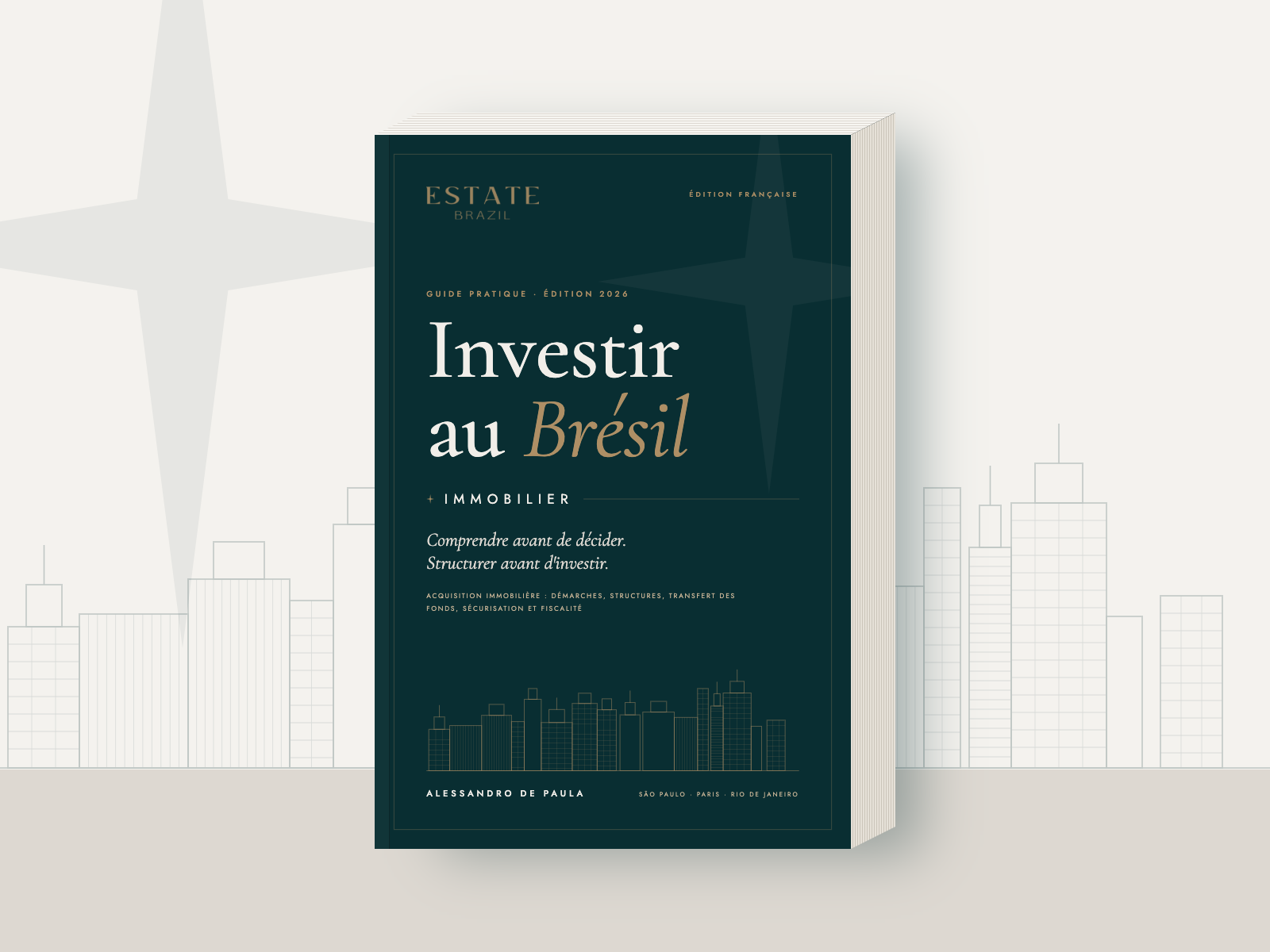
Investir au Brésil — Practical guide
164 pages | 2026 Edition | Available in French
Looking to explore these questions in greater depth and discover many other essential aspects of structuring, executing and protecting your real estate investment in Brazil?
Discover our exclusive 164-page guide, developed by the Estate Brazil team, drawing on several years of international experience in law, real estate and wealth structuring, under the editorial direction of Alessandro de Paula, a lawyer qualified in Brazil with master's degrees from the Sorbonne and Université Paris Dauphine-PSL.
Property acquisition, legal due diligence, taxation, wealth structuring, international capital transfers and investor visas: a practical, legally grounded approach featuring simulations, case studies, checklists and legislative references.
From choosing the right ownership structure to the eventual resale of your property, this guide helps you understand the legal and financial implications of each decision, anticipate costs, identify risks and avoid potentially costly mistakes.
Featuring legal and tax information updated in November 2026, including the key implications of Brazil's tax reform for real estate investments, this publication has been specifically designed for international investors seeking to make informed decisions and develop a secure investment strategy.
Investing in Brazil: master every step of your real estate investment

